Header widget area left

Our Tools

We have developed a number of tools through our extensive experience with implementing change. Most tools have evolved over time and have been incorporated into the Walk Together Design when they have been tested and shown to work well.

The tools are:

  • The Walk Together Design Principles
  • Mutual Ways
  • The Strategic Action Framework (SAF)
  • The Seven Ss
  • Monitoring and Review
  • The Governance Wheel
  • Partnerships

While not a tool, the Walk Together Principles are the key to ensuring the Design works effectively. If any or all of these Principles are omitted or not given due consideration, it is likely the project will rely on external motivation and ultimately fail, or will fail because community values are not being respected.

The principles are:

  1. Community initiated: meaning that before the idea moves beyond a vision, as a minimum, a group of community members indicate willingness to be engaged and participate
  2. Sustainable: there must be adequate financial or in-kind and people resources ensure the first two stages of the SAF can be undertaken
  3. Partnerships: the idea of collaborating rather than competing with other entities who aspire to a similar vision
  4. Learning by doing: enacting ideas in ways that help others to learn the accurate meaning of what has been suggested
  5. Two way: accepting and enacting ideas from other cultures to test their viability
  6. Monitoring: using statistical (quantitative) and interview (qualitative) data to measure progress on, for example, a bi-monthly basis
  7. Governance: a structure that is responsible for the direction, resourcing and outcomes of a design, to which a manager or management group reports
  8. Accountability: the action of accounting – for example, reporting – on tasks or duties that were set for various individuals or groups

If you would like further information, feel free to contact us.

Mutual Ways

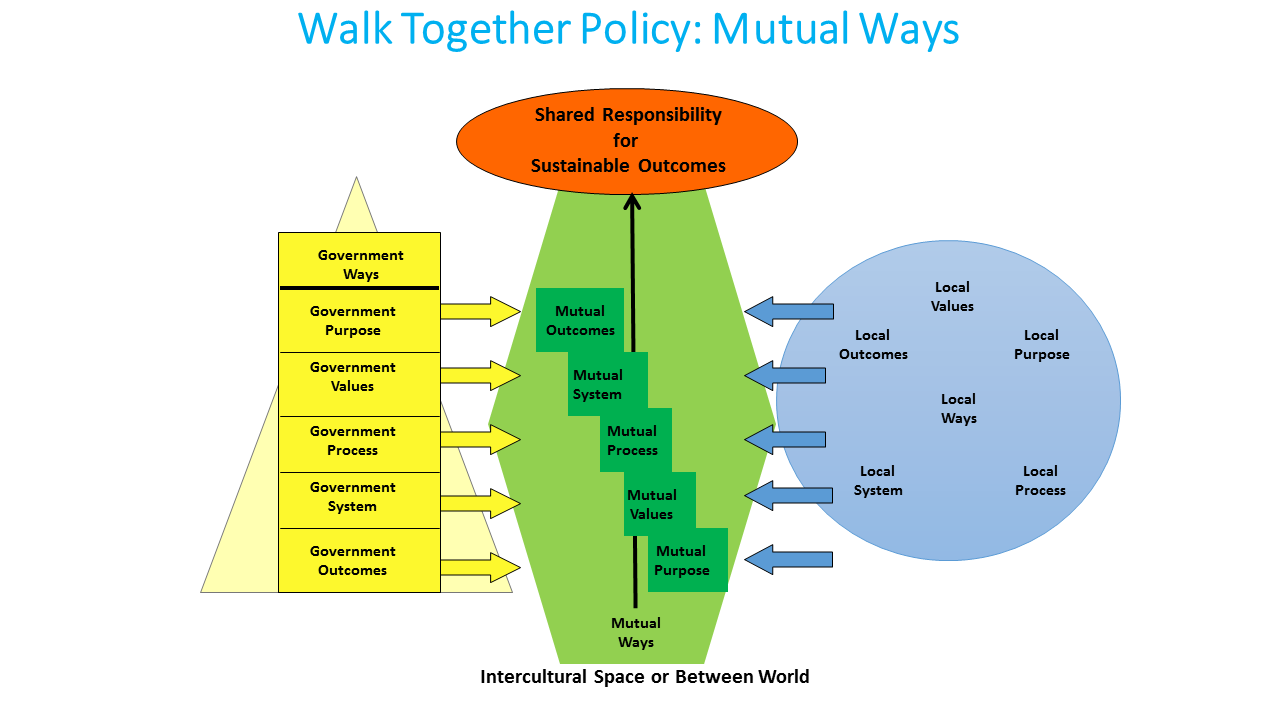
Mutual Ways is the basis of the Walk Together Design. It is, in effect, the policy under which the Walk Together Design should always operated for improved outcome in, and effective operations of, Indigenous communities. And it has stages: the first being where intended partners meet separately in a facilitated process to decide their vision, goals and strategies. Only when each group has unified ideas on these are different groups brought together, again in a facilitated process.

In other words, Mutual Ways is a method of working where there is shared authority and responsibility from the outset. Anything else is likely to fail because it does not create essential relationships in an “intercultural space” or “between world”. Mutuality of purpose, values, processes, systems and outcomes are the key foci.Mutual Ways-Slide1

Strategic Action Framework

The Strategic Action Framework (SAF) is the road map for change. It encompasses five phases and twenty objectives, each of which must be attended to if the Walk Together Design is to be effective.

The SAF is a guide to developing sustainable projects, a risk-management tool and planning tool. It is like a railway line and each numbered box is a station through which the train must pass. So each station contains an objective that must be achieved prior to moving on.SAF-Slide1
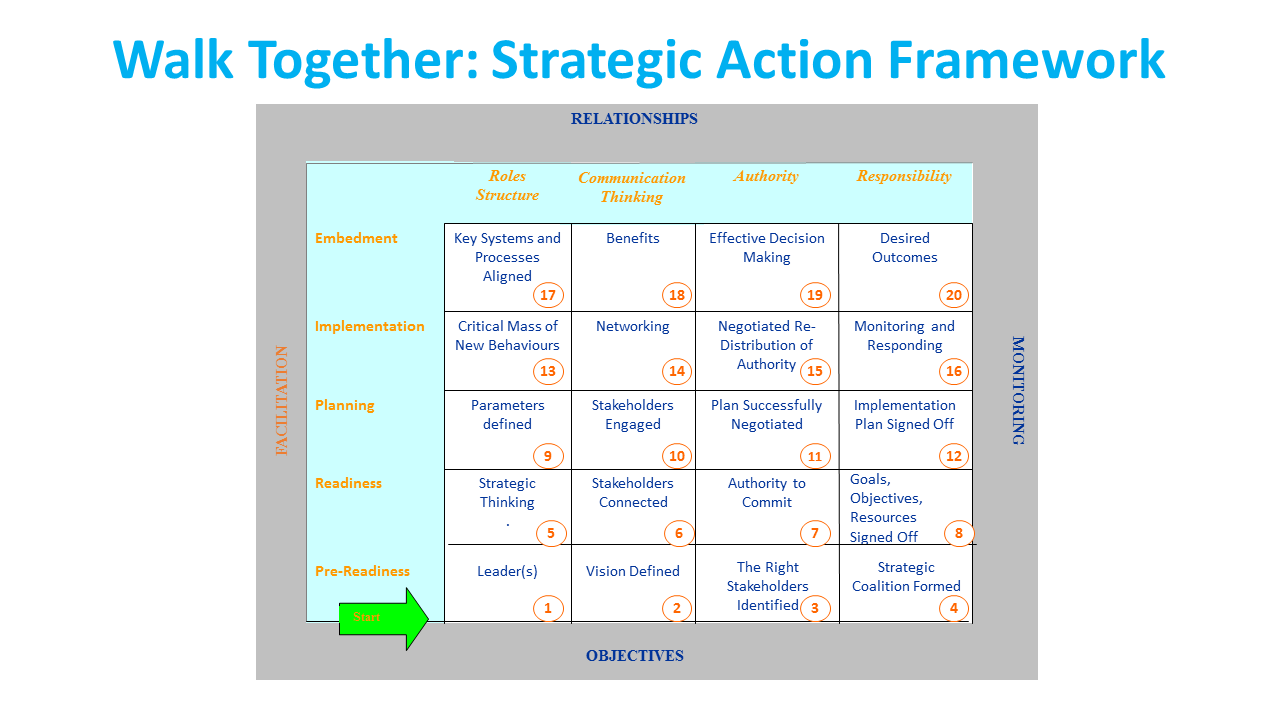
The four key strategies for the success of a project operating under the SAF are those of Relationships, Facilitation, Objectives and Monitoring. Without any one of these, the process fails.

There are five Phases on the left hand side of the diagram commencing with Pre-readiness. These are the levels through which an idea must pass to reach fruition : what CSCPL calls Embedment, which means that new practices have become standard. There are four headings under the word Relationships:

  • roles/structure
  • communication/thinking
  • authority
  • responsibility

Each of will probably change, and generally will need to change, as the Design progresses up to each new Phase
The Seven Ss

The Seven Ss are what we term the seven elements for risk management on progressing Walk Together. Each element can be used to review the overall project or program when issues arise or as a means of determining future actions. Each needs little explanation but feel free to contact us if you would like more information.

The Seven Ss are:

  1. Small: Start small and grow. Don’t attempt too much in too short a time with too few resources as is often the case in too many projects
  2. Strengths: Work with the strengths of people and their ideas, not what you perceive as failings that need to be corrected
  3. Success: Start with things that are working or have worked and will quickly be seen as successful
  4. Speed: Work at a pace that keeps everyone involved
  5. Sustainable: Have the essential resources and commitment before you start
  6. Simultaneous: Work with all people all the time
  7. Scrutinize: Monitor and review from the outset

Monitoring and Review

Monitoring and review is a crucial aspect of the Walk Together Design.

It has two major aspects to it, both of which are part of the work of the Design and which CSCPL consultants will work to make happen, particularly in relation to governance:

  • Monthly and Quarterly Progress Reports
  • Group reviews of progress reports on process and planning for the next stage

Summative reports (ie, what has been achieved) are provided by periodic (probably annual) syntheses of the monthly and quarterly reports, the individual stories of the participating communities, measurement data and an annual external review of some form.

Two types of measurement data are used:

  • the measurement of identified goals (what is being achieved)
  • the way the process is being undertaken (how the goals are being achieved)

Because Projects are community initiated, the goals identified must be relevant and understandable to community members.

The section on monitoring and review under the Walk Together Design heading in this site provides more detail and ideas. Alternatively, feel free to contact us .

The Governance Wheel

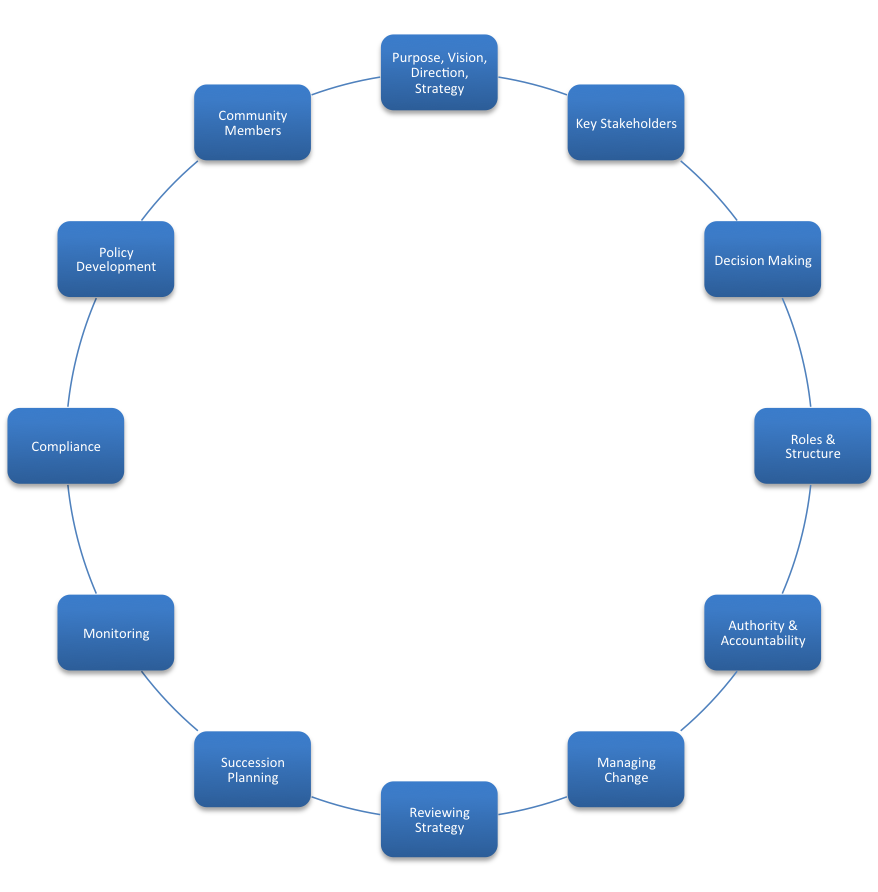
The Governance Wheel has been developed by CSCPL to show all the functions that a Board or Council performs.  Funding agencies often focus on compliance, particularly in relation to Indigenous agencies, but as there are four key areas and twelve aspects to the Wheel; compliance is only one aspect of governance.

CSCPL works with communities and organisations using the Walk Together Design as part of the overall process/ If necessary, however, specialised workshops on each strand of governance can be organised. The workshops are customised to suit the needs of each site.

The Governance Wheel has four strands:

  1. “Navigating the Way Forward” which includes the aspects of Community Members, of Purpose, Vision, Direction, Strategy and of Key Stakeholders
  2. “Meeting obligations” which includes the aspects of Policy Development, of Compliance and of Monitoring
  3. “Decisions and Implementation” which includes the aspects of Decision Making, of Roles and Structures and of Authority and Accountability
  4. “Building Capacity for the Future” which includes the aspects of Succession planning, of Reviewing Strategy and of Managing Change

Three important outcomes of our approach to governance training are in enabling Board or Council Members to:

  • understand the functions of Boards and Councils and individual roles
  • evaluate how activities in the organisation connect to it’s purpose
  •  understand that all four strands, working together, are necessary for effective governance.

Workshops are based on action methods exploring issues raised by participants. We have found this experiential, facilitative and action-based approach is superior in terms of participant satisfaction to more traditional approaches that focus on the delivery of content via dot points.

To find out more on the Governance Wheel please contact us.

Partnerships

Partnerships are a crucial to successful outcomes of the Walk Together Design. Indigenous groups that CSCPL has worked with have been open about this: the need to draw on and learn from the skills of non-Indigenous people and entities as they draw on and learn from the skills of Indigenous people. In addition, the concept of commencing the Walk Together Design in communities or townships creates the need for partnerships within that locality to be formed, for example between a health service and school for mutual benefit for children.

Which partnerships are developed, why, with whom and how, are the authority and responsibility of the groups meeting to create the change. They will know, better than any outsiders, where the strengths and potential for success is already visible, and how to generate new and exciting steps with partners rather than competitors and rivals.

Have a question? Contact us now.

Contact us on info@cscpl.net, or ring Colin (0415271783) or Dave (0419048897).

Not sure about our services?

Lorem ipsum dolor sit amet, consectetur adipisicing elit, sed do eiusmod tempor incididunt ut labore et dolore magna aliqua.